Akshita Rao
Akshita Rao
Fifth-year PhD candidate, Bioengineering · Neural Interaction Lab, Stanford University
Advised by Todd Coleman and Jamie Zeitzer
I build dynamical models of physiological oscillations to understand how the body and brain coordinate — and to turn that coordination into biomarkers you can actually measure outside a lab. My thesis treats the human stomach as an information-rich oscillator: I use noninvasive electrogastrography (EGG), high-density EEG and wearable autonomic sensing to study sleep, recovery and performance.
I anticipate defending in May 2027 and am open to collaboration and future opportunities. I am always happy to learn more ways we can apply oscillator dynamics in multimodal physiology or wearable sensing to deepen our understanding of human performance.

Explore the work
One signal, three levels of inference
A single noninvasive gastric recording can be read three ways. Pick a level below and change the conditions to see what each one measures.
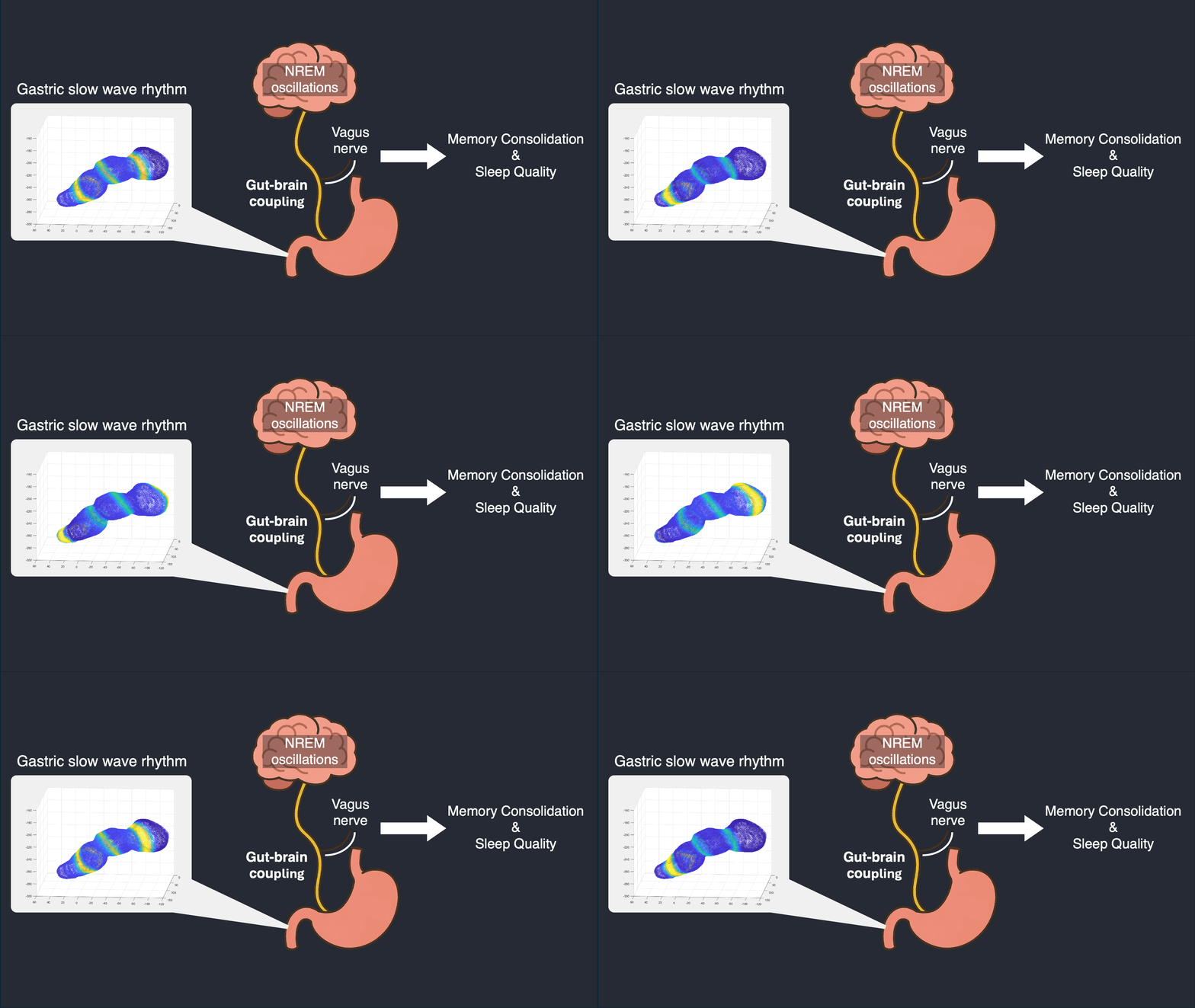
Does the stomach track the sleeping cortex?
Gastric slow waves keep running through the night. Their amplitude rises and falls on an infraslow timescale — and that envelope tracks infraslow fluctuations in cortical spindle-band (sigma) power. How tightly depends on the sleep stage.
Sleep stage
- Gastric amplitude
- —
- Infraslow alignment
- —
- SO–spindle locking
- —
Illustrative simulation of the model, not recorded data.
What does amplitude do to frequency?
Standard EGG analysis reports one dominant frequency and stops. Modelling the signal as a stochastic Stuart–Landau oscillator adds one more parameter — phase-shear β — that says how much the rhythm speeds up or slows down as it gets stronger. Drag β and watch the cycles stretch.
- β (phase-shear)
- —
- Amplitude → frequency
- —
Illustrative simulation. In the paper, phase-shear magnitude separated gastric dysfunction from healthy controls using a single electrode.
Does any of it survive outside the lab?
The first two aims live in a sleep laboratory with 64 EEG channels. This one asks whether a couple of abdominal electrodes, worn at home over repeated nights, still carry the signal — and whether the stability of overnight gastric rhythms indexes autonomic resilience and overnight restoration.
Setting
- Channels
- —
- Nights per participant
- —
- Participant burden
- —
Study design. Data collection is ongoing — no results yet.
One signal, three levels of inference. Gastric slow waves recorded noninvasively at the abdomen track cortical sleep architecture, encode the stomach's own nonlinear dynamics, and stay measurable in ambulatory recordings.
Selected work