Research
I develop signal-processing and statistical-modeling approaches for multimodal physiology. The through-line is treating physiological signals as dynamic oscillators rather than static summaries: modeling how rhythms in different organs coordinate, how amplitude and frequency co-evolve within a single rhythm, and what survives when you move from a sleep laboratory to a wearable.
Dissertation
Engineering dynamical biomarkers from gastric electrophysiology
Human physiological oscillations are usually analysed one organ at a time, or compressed into static summaries. My thesis argues that a single noninvasive gastric recording supports three distinct levels of inference — how the stomach coordinates with the brain, how amplitude and frequency co-evolve within the gastric oscillator itself, and whether those markers survive outside the laboratory.
AIM 01
Stomach–brain coupling during human sleep
Gastric rhythms track cortical sleep architecture, and predict memory and sleep quality.
AIM 02
Nonlinear oscillator models of gastric electrophysiology
Phase-shear captures how amplitude bends frequency, from a single electrode.
AIM 03
Dynamic gastric biomarkers in ambulatory settings
Does the signal survive at home, across repeated nights?
Dissertation · Aim 1
Stomach–brain coupling during human sleep
Question. Does the sleeping brain stay coordinated with peripheral organs, and does that coordination carry functional information?
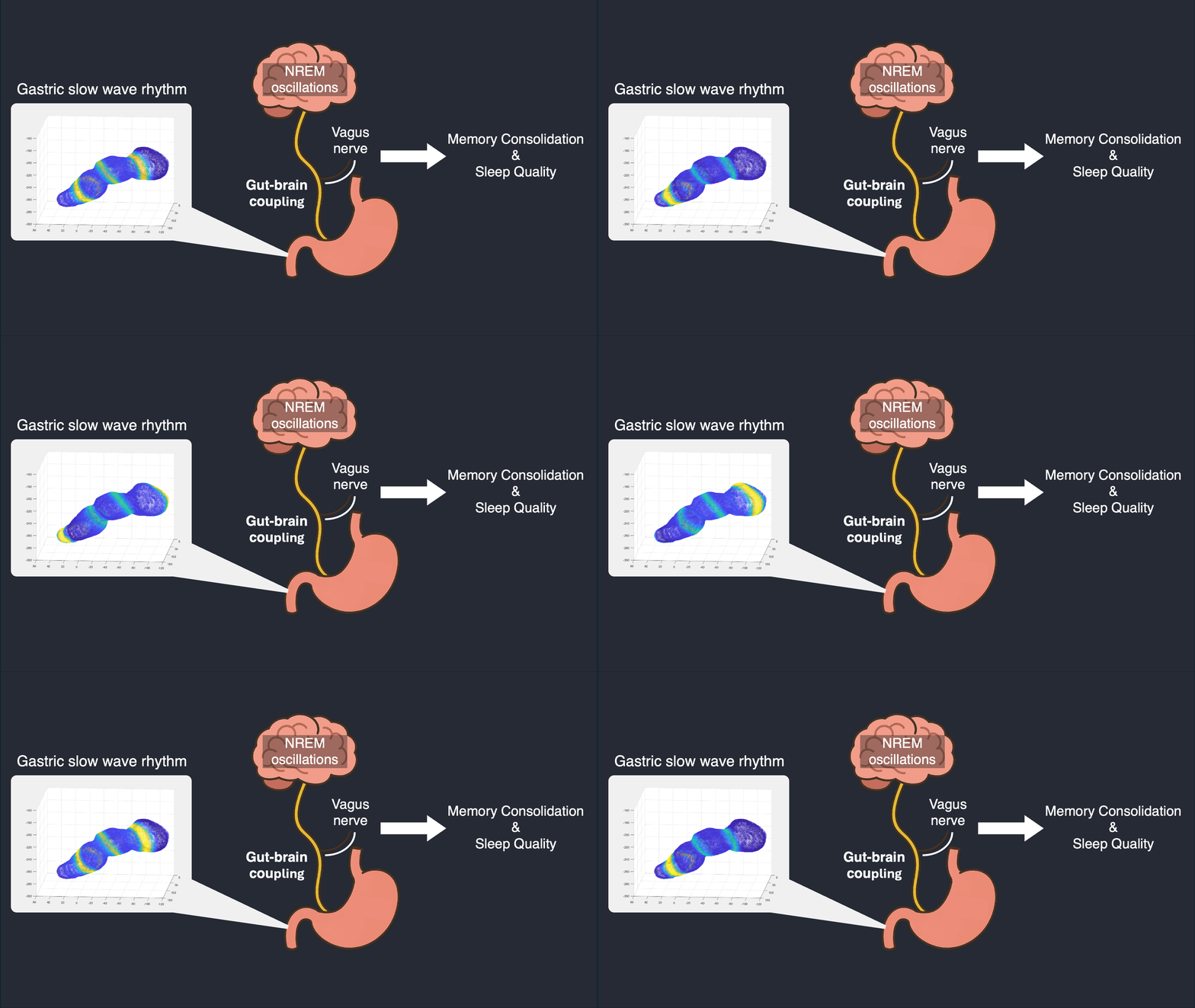
Sleep is usually described from the cortex outward. Using simultaneous 64-channel EEG and electrogastrography (EGG) recorded overnight in 60 healthy adults, I built a cross-frequency, event-linked framework for quantifying stomach–brain electrophysiology across NREM sleep. Three findings anchor the work:
- Gastric phase aligns with cortical delta and sigma activity, and coupling is strongest during coupled slow-oscillation–spindle events.
- Gastric power itself fluctuates at an infraslow timescale that tracks infraslow sigma-power fluctuations during deep sleep.
- Stomach–brain coupling relates to next-day memory recall, and gastric dynamics explain subjective sleep quality beyond conventional polysomnographic and cardiac measures.
Together this reframes sleep as a coordinated multi-organ state, and shows that a noninvasive abdominal electrode adds information that scalp EEG alone does not provide.
Methods: time–frequency decomposition, phase–amplitude coupling, event-triggered averaging, linear mixed-effects models, permutation testing.
Dissertation · Aim 2
Nonlinear oscillator models of gastric electrophysiology
Question. Conventional EGG analysis reports dominant frequency, power, or phase. What information is thrown away by never modeling how amplitude and frequency interact?
I represent the gastric-band analytic signal as a stochastic Stuart–Landau oscillator and estimate effective phase-shear — a normalised measure of amplitude-dependent frequency modulation. Across overnight recordings in 60 healthy participants, phase-shear was consistently negative, generalised to held-out halves of each recording, and was abolished by surrogates that break amplitude–phase alignment while preserving amplitude structure.
Applied to fasted and fed recordings from healthy participants and participants with gastric dysfunction, phase-shear magnitude differed between groups and classified dysfunction comparably to the strongest multielectrode traveling-wave measures — from a single electrode. The broader claim: modeling amplitude and phase jointly yields more interpretable and more measurement-efficient biomarkers.
Methods: stochastic differential equation fitting, parameter-recovery simulation, surrogate testing, out-of-sample validation, classification benchmarking.
Dissertation · Aim 3 · In progress
Dynamic gastric biomarkers in ambulatory settings
Question. Do laboratory-derived gastric markers hold up in the real world?
I am running a longitudinal ambulatory study in which participants record overnight gastric activity at home across repeated nights, alongside measures of pre-sleep stress, sleep quality and next-day activity. The hypothesis is that the stability of overnight gastric rhythms indexes autonomic resilience and overnight restoration — giving a low-burden signal that complements existing wearable measures of recovery. Data collection is ongoing; analysis pipelines are in place.
Related work
Wearable autonomic sensing for concussion recovery
With the Stanford SPARCC concussion clinic, I deploy consumer smartwatches to collect single-lead ECG and PPG during an exertional assessment protocol, and maintain the cloud pipeline that turns raw signals into autonomic metrics and clinician-facing reports. The engineering problem here is trustworthiness: signal quality indexing, robust feature extraction, and understanding how autonomic measures behave across devices, behavioural states and noisy real-world conditions.
Methods: signal quality indexing, HR/HRV feature extraction, serverless data pipelines, validation and benchmarking.
Interpretable machine learning for facial palsy
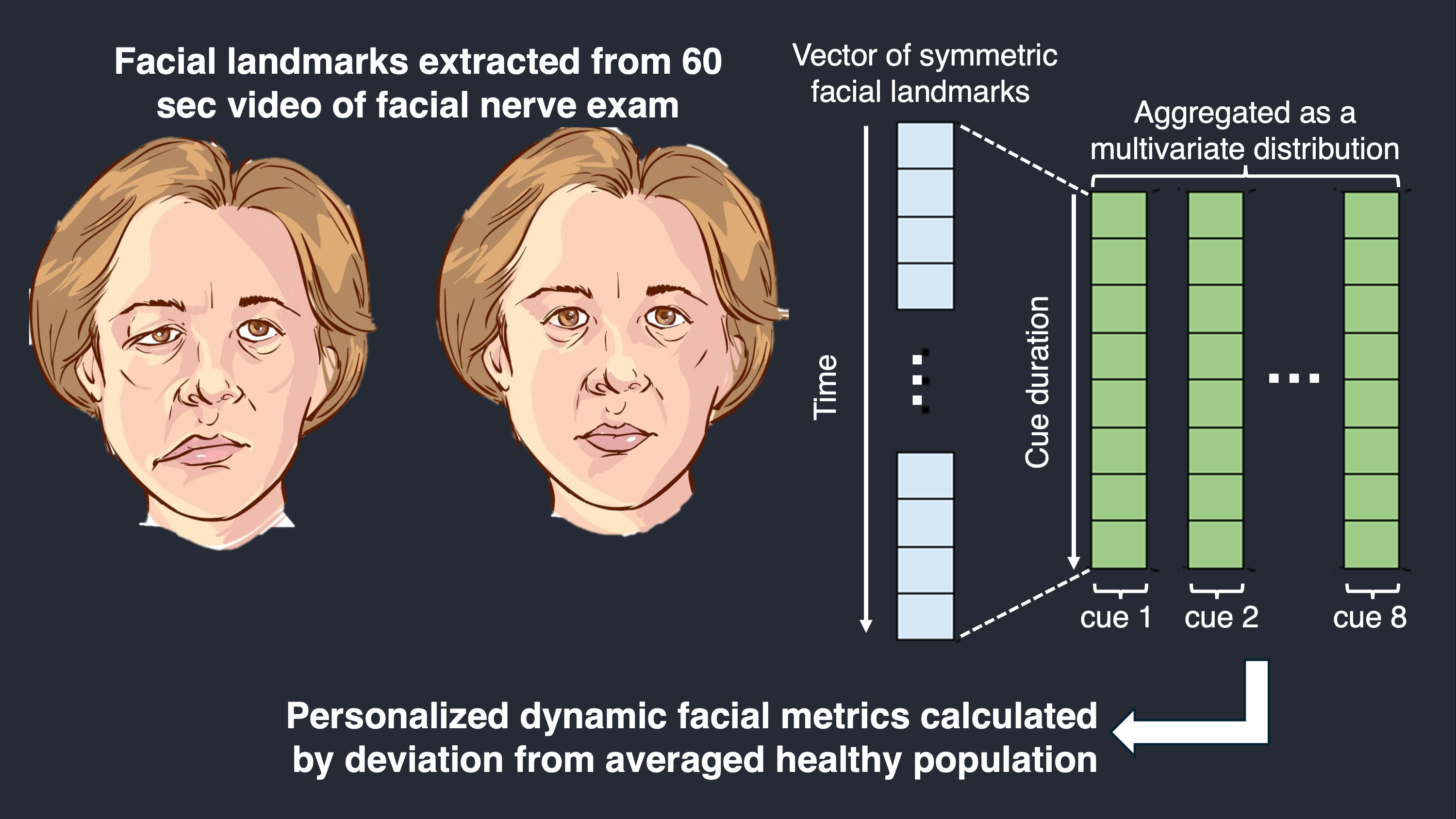
Clinicians assessing facial-nerve recovery rely on subjective description, coarse ordinal scales and static photographs. I developed video-based methods — likelihood ratio tests, optimal transport, and Mahalanobis distances over facial landmark trajectories — to classify palsy type, localise asymmetric regions, and map movement dynamics onto clinical House–Brackmann scores. A follow-up compared modern landmark detectors and replaced least-squares regression with ordinal regression, which better respects the ordered structure of the grading scale and meaningfully reduced prediction error.
Goal: give surgeons objective, longitudinal evidence for facial reanimation decisions.
Earlier work: bioelectronics for cardiac tissue engineering
Before Stanford I built integrated bioelectronic platforms for monitoring and modulating engineered cardiac tissue — flexible multi-electrode arrays for 3D culture, heart-on-a-chip systems for recording electrophysiology under acute hypoxia, and combined optogenetic and bioelectronic interfaces for long-term stimulation and recording.
Tools & collaboration
Python for signal processing and modeling (MNE, NumPy/SciPy, statsmodels, scikit-learn, PyTorch), with reproducible pipelines on HPC. I am always interested in collaborations on multimodal physiology, oscillator models, wearable analytics, and clinical translation — get in touch.